
Brewery Chillers
A glycol chiller, also known as a brewery chiller, is the difference between guessing at fermentation temperature and actually controlling it, whether that's a five-gallon batch in a garage or a 15 BBL tank in a production brewhouse. The same holds for wine, cider and mead: get the temperature wrong and no amount of good ingredients saves the batch.
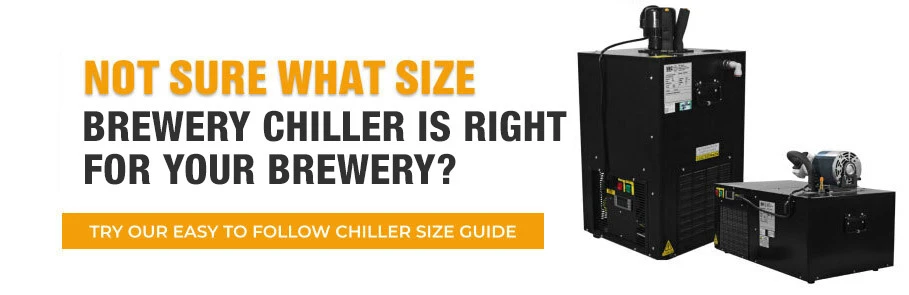
The BrewChill Pro lineup covers that whole range. The smaller models fit serious homebrewers running multiple conical fermenters who've outgrown ice baths and wet towels. The larger models are built for breweries, wineries and cideries running production tanks. If you're not sure where your setup falls, our Brewery Chiller Sizing Calculator walks through it in a couple minutes.
Why Fermentation Temperature Control Matters
A few processes need it more than others:
- Cold crash after fermentation
- Holding a steady temperature during active fermentation
- Cooling wort after the boil
Ambient temperature alone rarely gets you there. A room can run too cold in winter and too warm in summer, and fermentation itself generates heat on top of that. It's common to have a room sitting at a stable 67°F while the batch inside the fermenter is running in the low 70s. Ice baths and wet towels can pull that down temporarily, but they don't hold a temperature, they just react to whatever it already is.
Style matters here too. Lager strains need consistently cooler temperatures than ale strains, usually in the low 50s°F, and some Belgian strains only produce their signature flavor within a narrow band. Wine and cider fermentations have their own temperature windows depending on the style. A brewery chiller holds the line automatically instead of asking someone to babysit a thermometer.
How Does a Brewery Chiller Work?
It works on the same principle as a refrigerator: a compressor, evaporator, condenser and metering device work together to pull heat out of a fluid loop. Set a target temperature, and the chiller kicks in whenever things drift off it. The same core design shows up in a small conical fermenter chiller and a full production BrewChill Pro unit, just scaled differently.
The fluid doing the work is food-grade propylene glycol, the industry standard coolant for anything touching beverage production. Larger BrewChill Pro models run multiple pumps, so one chiller can serve more than one tank or fermenter at a time. Check each model's spec sheet for exact pump count and whether it runs on a shared setpoint or independent zones, since that varies across the lineup.
Questions about sizing, specs or anything else? Get in touch with the BeverageCraft team, live chat, email or phone all work, and we'll help you figure out the right fit.