
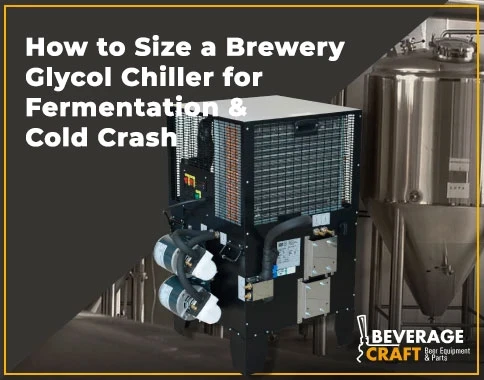
How to Size a Brewery Glycol Chiller for Fermentation and Cold Crash
Posted by Ron on 26th Aug 2026
Choosing a brewery glycol chiller isn't just about matching a number on a spec sheet. It's about knowing how much heat your process actually needs to remove, when it needs to be removed and how that changes as your operation grows. This guide walks through what actually determines chiller size - for fermentation, cold crash and tank holding, across beer, wine, cider and mead - so you can make a confident choice instead of a guess. If you'd rather skip straight to a recommendation, our Brewery Chiller Sizing Calculator does the math for you.
- A glycol chiller provides temperature control for fermentation, cold crash and tank holding.
- The right size depends on tank volume, process type, how many tanks may require cooling at the same time, ambient conditions and glycol loop length - not your total tank count.
- This isn't beer-only. Wineries, cideries and meaderies run the same type of system.
- An undersized chiller may struggle to hold temperature under peak load. An unnecessarily oversized system adds upfront and operating cost.
- Skip the manual math - use our free Brewery Chiller Sizing Calculator.
What Is a Brewery Glycol Chiller?
A brewery glycol chiller cools a glycol-water mixture and circulates it through jackets or coils on your tanks, pulling heat out of the beverage inside. It's the same basic principle behind any refrigeration system, applied to fermenters, brite tanks and conditioning vessels instead of a walk-in cooler. The chiller doesn't need to know what's brewing - it just needs to remove heat fast enough and consistently enough to keep the tank at your target temperature.
What Is a Glycol Chiller Used For?
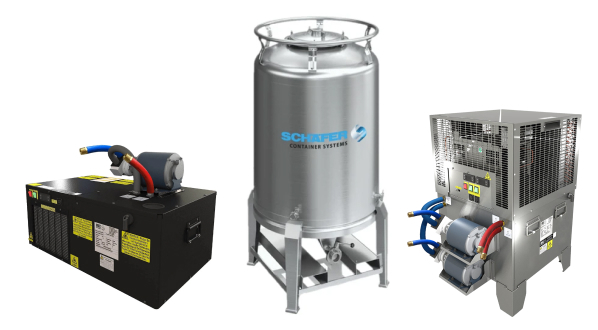
Most producers think of glycol chillers as a beer-only tool, but the same system handles three distinct jobs - and it isn't limited to beer.
What Determines the Right Chiller Size?
Tank volume matters, but on its own it doesn't tell you what chiller you need. A larger tank generally needs more cooling capacity because there's more liquid to cool - but volume is only the starting point.
The same tank can need very different chiller capacity depending on which stage it's in:
| Stage | What's Happening | Typical Load |
|---|---|---|
| Fermentation | Yeast generates heat continuously | Continuous heat removal is needed to hold the target temperature |
| Cold Crash | Actively pulling temperature down | Higher, more concentrated cooling demand during the pull-down |
| Tank Holding | Beverage already at target temperature | Mainly offsets heat entering the tank from the surrounding environment |
The same 15 BBL tank can have very different cooling requirements depending on the stage it's in, along with target temperature, cooling time and operating conditions.
Don't Forget the Glycol Loop
Chiller capacity isn't the only variable. A chiller can have enough cooling capacity for the calculated load, but the overall system still needs to be configured so glycol can circulate effectively between the chiller and each tank. If your tanks are spread across a large space, or you're adding a second production area, factor in the total supply-and-return run, line sizing and system configuration - not just tank volume.
Should You Plan for Future Expansion?
If adding tanks is part of your near-term production plan, factor that in before choosing a chiller - a system sized only for today's setup may need to be upgraded sooner than expected. That said, there's little reason to significantly oversize a system for an expansion that may never happen. Size for what's realistically on your roadmap, not for every "someday."
What's Actually in a BrewChill Pro System?
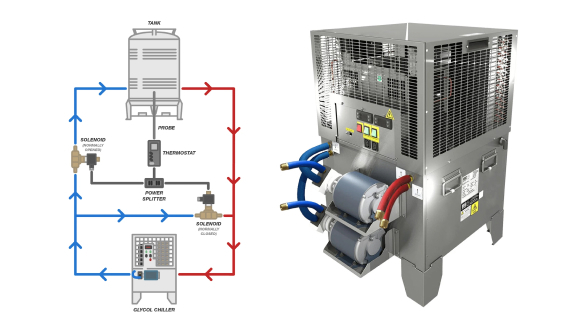
A glycol chiller isn't just the compressor unit. Most systems include a glycol reservoir, one or more pumps to circulate glycol out to your tanks, and temperature-control equipment - with the exact configuration varying by model. Some models run multiple pumps off a single shared thermostat, which lets you route glycol to more than one tank but holds them all to the same setpoint. Others use a separate thermostat and compressor per zone, which lets each zone run at its own target temperature. That distinction matters more than pump count alone if you need, say, one tank fermenting warm while another is holding cold on the same chiller.
How to Choose the Right BrewChill Pro Capacity
Once you know roughly what your setup needs - process type, simultaneous tank count, cooling window, ambient conditions and loop length - you can compare that against the available BrewChill Pro models. The lineup spans a range of cooling capacities and configurations, so breweries, wineries, cideries and meaderies of different sizes can match a system to what they're actually running today, with room to grow into.
| Model | Approx. Capacity | Zone Configuration | Example Application |
|---|---|---|---|
| BrewChill Pro 3200 | ~3,200 BTU/hr | Single zone | Smaller cooling applications |
| BrewChill Pro 4000 | ~4,000 BTU/hr | Single zone (optional second pump for multi-tank routing, one setpoint) | Small beverage production systems |
| BrewChill Pro 5500 | ~5,500 BTU/hr | Two pumps, shared setpoint | Higher cooling demand |
| BrewChill Pro 7500 | ~7,500 BTU/hr | Two to three pumps, shared setpoint | Larger cooling requirements |
| BrewChill Pro 13000 | ~13,000 BTU/hr | Independent dual zone - separate thermostats and compressors | Higher-demand, multi-zone applications |
Actual chiller selection depends on the combined cooling load and system configuration, not tank count alone.

The Bottom Line
The right glycol chiller is based on your cooling requirements, not simply tank volume or tank count. Start with your process types, target temperatures and cooling times, then factor in how many tanks may run at once, your operating environment and glycol loop length. If you're not sure what capacity that adds up to, our sizing calculator estimates it for you and points to a suitable BrewChill Pro model.
Frequently Asked Questions
Is a brewery glycol chiller only for beer?
Should I size my chiller for every tank I own?
Does fermentation or cold crash require a bigger chiller?
Does tank insulation actually affect chiller sizing?
Should I buy a bigger chiller than I need right now?
What if my tanks are far from where the chiller will sit?
Answer a few questions about your tanks and process, and get a model recommendation in minutes.
Use the Sizing Calculator