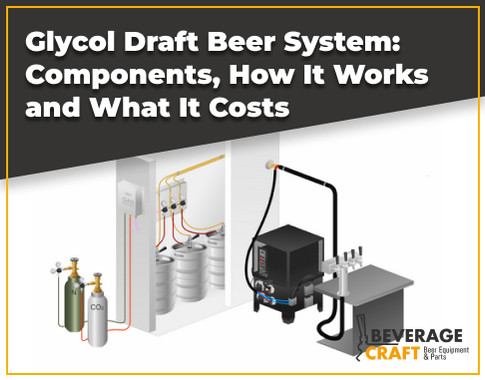
Glycol Draft Beer System: Components, How It Works and What It Costs in 2026
Posted by Ron on 4th Aug 2026
If your walk-in cooler sits more than 25 feet from your taps, a glycol system is what keeps the beer in that gap from turning into foam. It circulates chilled, food-grade propylene glycol alongside the beer lines the whole way from keg to faucet, holding the beer at 36-38°F (2-3°C) no matter how far it has to travel. Shorter setups, like a kegerator tucked under the bar, usually don't need one. A simple air-cooled or direct-draw kegerator setup does the job just fine for those.
Every glycol system, no matter how big, comes down to three parts: a glycol power pack (the chiller), a trunk line and a beer tower. Below, we break down how each one works and what it actually costs to build a system in 2026, based on current BeverageCraft pricing.
A complete glycol system for a 4-tap bar typically runs $2,500 to $8,000, before installation.
What a Complete System Runs You
| Component | Function | Price Range (2026 USD) | Where to Buy |
|---|---|---|---|
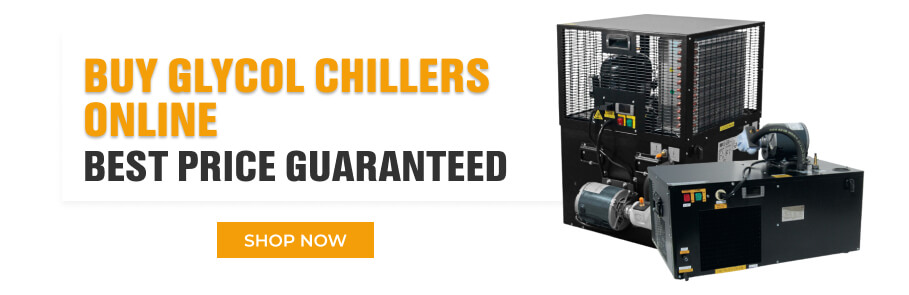
| Glycol Power Pack (Chiller) | Refrigerates and circulates glycol through the trunk line | $1,200 - $8,080 | Shop Glycol Chillers → |
| Trunk Line | Insulated bundle carrying beer and glycol lines from cooler to tower | $6 - $26 per foot | Shop Trunk Lines → |
| Draft Beer Tower | Houses the faucets and shanks where beer is actually poured | $210 - $5,500 | Shop Beer Towers → |
| CO2 / Nitrogen Cylinders | Supplies the gas pressure that pushes beer out of the keg | $160 - $330 | Shop Gas Tanks → |
| Primary Gas Regulator | Steps tank pressure down to a workable dispensing range | $65 - $150 | Shop Regulators → |
| Secondary Gas Regulator | Fine-tunes pressure for each individual keg in multi-product systems | $75 - $545 | Shop Regulators → |
| Gas Blender | Mixes CO2 and nitrogen for nitro or blended-gas beers | $1,100 – $2,325 | Shop Blenders → |
| Keg Coupler | Locks onto the keg valve, letting gas in and beer out | $50 – $280 | Shop Keg Couplers → |
| Beer Faucet | The point where beer leaves the system and hits the glass | $13 – $350 | Shop Faucets → |
A gas blender only enters the picture if you're pouring nitro or blended-gas beers. Skip it and your total drops accordingly. Distance and tap count move the number more than anything else, which is why sizing matters as much as the parts list itself.
Need glycol system components?
BeverageCraft stocks every part, from power packs to faucets. Ships across Canada & USA.
What Is a Glycol System?
Glycol beer cooling system is one of the two main draft beer system options (the second one being forced-air) used in bars, pubs, tap rooms and restaurants to maintain the cold temperature of draft beer from the walk-in cooler to the dispensing tower. This is done mainly to prevent the foam buildup as the beer travels from point A (storage) to point B (draft tower).
Glycol draft beer systems use propylene glycol as the cooling agent (hence, the name). Glycol itself is a colorless, odorless, slightly syrupy chemical compound that is a bit thicker than water. It has many applications in the food industry but, for the majority of brewers and bar owners, it’s just a component of the glycol system.
This system is mainly used for long-draw beer dispensing setups (typically, running 25 ft or longer). It works especially great in situations where you have to store beer kegs in a walk-in cooler that’s located far from the bar counter where beer is actually dispensed.
How Does the Glycol Beer System Work
Although glycol-cooled draft beer systems consist of dozens of components, the three main ones will always be these:
Power Pack
The refrigeration unit that chills glycol and pumps it through the system.
Trunk Line
The insulated bundle carrying beer and glycol lines from cooler to tower.
Beer Tower
Where the beer lines end and the faucets actually pour.
Glycol Power Pack
The glycol power pack, also called a glycol chiller, is the heart of the whole setup. It's a commercial refrigeration unit built to chill glycol and pump it continuously through the system.
Inside a power pack, you'll find a compressor, an evaporator fan, a thermostat, a glycol reservoir with a cooling coil and the supply and return lines that carry glycol out to the trunk line and back. The coil chills the glycol sitting in the reservoir. A pump keeps that glycol moving through the supply line around the clock, while the compressor cycles on and off to hold whatever temperature the thermostat is set to.
Trunk Line
If the power pack is the heart of the draft beer glycol system, the trunk line is its blood vessel. It's a bundle of beer lines (anywhere from 2 to 16, depending on the setup) wrapped around a pair of glycol lines, all sealed in foil and insulation and encased in a waterproof jacket.
One glycol line runs out from the power pack to the tower; the other carries it back to be re-chilled. Each beer line inside the bundle connects to its own keg in the walk-in cooler and those kegs get their pressure from CO2 or nitrogen tanks through a chain of regulators and gas blenders.
In short: the beer trunk line is the conduit that links every keg to its faucet at the tower, while also carrying the glycol loop that keeps the whole thing cold along the way. The bundle is wrapped in foam and jacketed in flexible, waterproof plastic that's easy to route through a building.
Installation is usually overhead or under the floor. Overhead runs typically go through a mix of PVC tubing and a decorative cover; under-floor runs go through a section of buried PVC.
Beer Tower
The beer tower is the easiest part to explain, since it's the only piece your customers ever see. Beer lines connect to a shank or faucet mounted inside the tower. Pull the tap handle, and out comes cold beer.
From behind the bar, this is where the whole journey ends. As you now know, that beer has come a long way to get there.
Glycol Draft System in a Nutshell: How It All Works
A full setup can look different from bar to bar, but the core idea stays the same across every installation: move beer over a real distance, sometimes hundreds of feet, while holding it steady the whole way.
Glycol vs. Forced-Air: Which System Do You Actually Need?
Not every bar needs a glycol system and it's worth ruling it out before you spend the money. Forced-air (direct-draw) systems push cold air through an insulated duct to a tower sitting directly on top of or right beside the kegerator, the way a standard bar-top kegerator has the keg stored right underneath. They're simple, cheap to install, and perfectly fine for a short run. Once the distance between the cooler and the tap grows past 25 feet or so, though, air just can't hold a consistent temperature over that stretch and you start getting foam.
| Feature | Glycol System | Forced-Air System |
|---|---|---|
| Best For | Long-draw setups (25-750+ ft) | Short-draw setups (under 25 ft) |
| Cooling Method | Propylene glycol circulating through the trunk line | Refrigerated air blown through an insulated duct |
| Temperature Consistency | Stays consistent even over long distances | Reliable for short runs, drops off over distance |
| Typical Use | Bars and restaurants with a remote walk-in cooler | Kegerators, under-bar coolers, direct-draw setups |
| Upfront Cost | Higher - roughly $2,500 to $8,000+ for a full setup | Lower - a few hundred to around $1,500 |
| Maintenance | Moderate - glycol level checks, annual flush, pump upkeep | Low - fan and filter cleaning |
If you're weighing portable options for outdoor events instead of a permanent bar setup, a jockey box or kegerator is usually the better fit than either of these. Neither glycol nor forced-air towers are built to be hauled around.
Building a draft beer system?
Browse all draft beer equipment, parts, and custom towers at BeverageCraft.
Sizing a Glycol Chiller for Your System
Undersizing a chiller is the single most common mistake we see. Get it wrong and the beer arrives warm during a rush, CO2 breaks out of solution, and you end up pouring foam all night, while the compressor runs nonstop and burns out early. Oversizing has its own downside: the unit short-cycles, switching on and off too fast, which stresses the compressor for no real benefit.
Chiller output is rated in BTUs, and the right size depends on two things: how many faucets you're running and how far the trunk line has to travel. As a rough guide:
| Trunk Line Distance | 4 Faucets | 8 Faucets | 12 Faucets |
|---|---|---|---|
| 25-50 ft | ~1,500-1,750 BTU/hr | ~1,950-2,250 BTU/hr | ~2,450-2,750 BTU/hr |
| 75-100 ft | ~2,050-2,375 BTU/hr | ~2,550-2,875 BTU/hr | ~3,050-3,375 BTU/hr |
| 150 ft | ~3,000 BTU/hr | ~3,500 BTU/hr | ~4,000 BTU/hr |
Always round up to the next chiller model, never down. The formula already builds in a safety margin. BeverageCraft's lineup runs from a 1,150 BTU unit for a 25-foot run up to 13,000 BTU water-cooled models rated for 750-850-foot systems, so most bars and taprooms fall somewhere in the middle of that range. Want exact numbers for your setup instead of the rule-of-thumb table above? Our BTU sizing calculator and full glycol chiller sizing guide walk through it faucet by faucet.
FAQ
How much does a glycol draft beer system cost?
What size glycol chiller do I need for my bar?
How far can a glycol draft beer system run?
What is propylene glycol, and is it safe for beer systems?
Glycol system vs. forced-air - which one should I install?
Where can I buy glycol draft beer system components in the USA and Canada?
All Glycol System Components by BeverageCraft
Glycol chillers, trunk lines, beer towers, faucets, regulators and every part you need to build or maintain a long-draw draft beer system. Ships across Canada & USA.
Shop Glycol Chillers Browse All Draft Beer PartsRelated Reading