

Best Kegerators for Home and Commercial Use
Posted by Dmitriy Krivchun on 2nd Nov 2026
The best kegerator fits the kegs you buy and the place where you serve. A home bar may need one refrigerated keg and a single faucet. A pub may need several beers on tap, room for replacement kegs and a cabinet that recovers quickly after frequent door openings.
This guide explains how home and commercial models differ and helps you choose by installation type and keg capacity. To see what is available now, browse our kegerators or go straight to commercial kegerators.
Quick answer: For one beer, start with a one-tap setup that fits the keg you buy. For two different beers, plan for two connected kegs and two beer lines. Choose built-in approval for installation inside cabinetry and outdoor rating for outdoor use. For a business, compare commercial kegerators for keg capacity, service access and the demands of your venue. Remote taps need cooling along the beer line route.
What Is a Kegerator and How Does It Work?
A kegerator is a refrigerator built to hold kegs and pour from them. Inside, the keg stays at serving temperature. In a standard CO2 setup, gas travels from the cylinder through a regulator to the keg. Regulated pressure pushes beer through the beer line to the faucet as it opens. The refrigerator keeps the keg cold; it does not create dispensing pressure. A beer tower carries the line to the faucet and needs a suitable cooling arrangement. Nitro drinks require a different gas and compatible serving equipment.
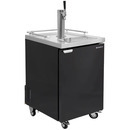 |
Cabinet. The refrigerated box that holds the kegs. Its inside dimensions decide which kegs fit. Refrigeration capacity, airflow and insulation decide how fast it gets back to temperature after the door opens. |
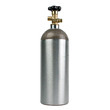 |
CO2 tank and regulator. The CO2 tank stores the gas. The regulator lowers tank pressure to the dispensing pressure your beer and system need. |
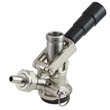 |
Keg coupler. Locks onto the keg valve and connects both the gas line and the beer line. Choose the coupler type that matches the keg valve. Ball-lock homebrew kegs use separate gas and liquid disconnects instead of this style of coupler. Our keg coupler types guide shows how to tell them apart. |
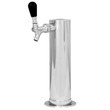 |
Tower and faucet. The tower sits on top of the cabinet and carries the beer line up to the faucet. How many faucets you get depends on the tower design. |
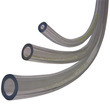 |
Beer line and air line. Food-grade tubing that carries beer from the coupler to the faucet and gas from the regulator to the coupler. |
Some kegerators ship with all of these parts and some ship as a bare cabinet. Check what is included before you order, so you know whether you need extra dispensing equipment before the first pour.
Home vs Commercial Kegerator: What Is the Difference?
Both types refrigerate kegs and use a gas system to dispense the drink. The difference is their intended workload and design. A home bar might serve one or two beers during an evening. A venue may need several connected kegs, quick access for changes and equipment suitable for daily food-service use. Those are different buying requirements, even when the cabinets look similar.
Commercial models are built for food-service use, but construction and cooling still vary from one model to the next. Compare refrigeration performance, interior materials and how easy the cabinet is to clean. For a licensed venue, ask your local health and electrical authorities which approvals they require. The word "commercial" in a product name does not prove those approvals on its own, so check the spec sheet.
| Feature | Home kegerator | Commercial kegerator |
|---|---|---|
| Typical use | Home bar; garage or patio only if the model is rated for it | Bar, pub, restaurant, café, taproom |
| Serving pattern | Household use; select the keg size and tap count you need | Repeated service; plan connected kegs, changes and cold reserve stock |
| Cooling | Static or fan-assisted, depending on the model | Compare airflow and refrigeration capacity for the expected workload |
| Interior | Compare the liner, floor and ease of cleaning | Look for durable, cleanable surfaces and access for servicing |
| Approvals | Check electrical approval and installation type | Check the sanitation and electrical listings your venue needs |
| Capacity | Usually one large keg or a few small ones | Single-door to multi-door; room for spare kegs on larger units |
A commercial model can work at home when its power supply, dimensions and ventilation suit the location. Compare noise and energy use too. For a business, choose a model rated for the intended use; cabinet size or stainless steel alone does not establish commercial suitability.
Types of Kegerators Explained
Home or commercial describes the intended use. Freestanding or built-in describes installation. Indoor or outdoor describes the environment. Cooling design and keg capacity are separate choices. One kegerator can be commercial, built-in and outdoor-rated at the same time.
Static vs Fan-Forced Cooling
Static cooling relies mainly on natural air movement around a cold surface. Fan-forced cooling uses a fan to circulate chilled air around the kegs, helping reduce temperature differences inside the cabinet. The fan does not by itself tell you the refrigeration capacity. Check tower cooling separately: a cold keg can still produce a foamy first pour if beer warms inside an uncooled tower.
Freestanding vs Built-In: Check the Ventilation
Every kegerator has to push out the heat it removes. A freestanding model needs the clearances listed in its instructions, usually at the back and sides. Many built-in models breathe through a front grille, but front venting does not always mean zero clearance. Check that the model is approved for built-in use and note every gap it needs. A blocked unit loses cooling power and can overheat its compressor.
Indoor vs Outdoor-Rated
An indoor model is designed for the environment specified in its manual. An outdoor-rated model is built and approved for outdoor conditions within its stated operating range. A roof over a patio does not turn it into an indoor location, and a stainless steel finish alone does not prove outdoor suitability. Check the outdoor rating and ambient temperature limits separately from built-in approval.
Single-Door vs Multi-Door Back Bar Units
A single-door cabinet suits a small beer selection as long as your kegs fit. Multi-door models give you more floor space, but tower count and keg layout differ from model to model. Spare kegs only fit if there is room left after every connected keg and its coupler are in place, so check the layout instead of judging capacity by the number of doors. A bottle-storage back bar refrigerator is not automatically a keg-dispensing unit; check the keg layout and tapping equipment.
Kegerator vs Glycol System
A direct-draw system keeps the faucet close to the refrigerated keg, commonly on a tower above the cabinet. When the taps are far from the kegs, the beer line has to be cooled along the whole route, and a bigger cabinet will not do that. Depending on the distance, a remote system uses forced-air or glycol cooling. For long-draw installations, a glycol chiller circulates coolant next to the beer lines, while the kegs still sit in their own refrigerated storage.
Which Kegerator Fits Your Situation?
- Choose the installation first. Decide whether the unit will stand in open space or sit inside cabinetry, and whether it will be used indoors or outdoors.
- List your connected kegs. Write down the number of different beers, each keg's actual size and any cold reserve stock you need.
- Match the cabinet and dispensing package. Confirm the keg layout, cooling arrangement and the equipment included with the selected option.
Use this table to choose the right type for your setup. The examples link to models and categories available from BeverageCraft. Check the current product specifications for keg capacity, installation requirements and included dispensing equipment.
| Your situation | What to look for | Why | BeverageCraft Model or Category |
|---|---|---|---|
| Home bar, freestanding | Freestanding model that fits your keg size | Light use, the door stays closed most of the time | Home kegerators |
| Built into cabinetry or an outdoor kitchen | Model approved for built-in use; also outdoor-rated for outdoor installation | Venting and clearances match the installation | 24" front-vented kegerator |
| Small bar or café, 1 to 2 beers | Commercial single-door cabinet with room for your connected kegs; KegMaster Pro is a nominal 24-inch example | Compact single-door format; confirm keg layout and the dispensing package | KegMaster Pro |
| Narrow spot behind the bar | Narrow-format cabinet with confirmed dimensions and ventilation space | Compare actual cabinet width and installation gaps before ordering | KegMaster Craft |
| Licensed venue that must show certified equipment | Sanitation and electrical listings your inspector accepts | Check the exact model's spec sheet before you buy | Summit model with published approval details |
| Pub or restaurant pouring four different beers | Keg-dispensing cabinet that fits four connected kegs; multi-door if more space is needed | Four connected beers require four kegs; reserve space depends on keg sizes | 58" two-tower kegerator |
| Coffee shop with nitro cold brew | Nitrogen-compatible setup with the correct faucet; the linked example uses an infuser | Nitro needs the right gas and serving equipment | KegMaster Pro Nitro Edition |
| Taps far from keg storage | Remote dispensing system designed for the route, often glycol-cooled | Keeps beer cold through long lines | Glycol chillers |

How to Size a Kegerator
Start With the Kegs You Will Buy
Ask your distributor which keg sizes they deliver before you pick a cabinet. Check each keg's diameter and height, then leave room for the coupler and hose bends. Internal steps and refrigeration parts also take up space. Keep in mind that a 50L keg is not the same size as a 15.5 US gallon half barrel, so a similar label does not guarantee the same fit.
| Keg type | Nominal volume | Example diameter |
|---|---|---|
| US half barrel | 15.5 US gal / 58.7 L | 16 1/8 in / about 41 cm |
| US quarter barrel, short | 7.75 US gal / 29.3 L | 16 1/8 in / about 41 cm |
| US slim quarter barrel | 7.75 US gal / 29.3 L | 11 1/8 in / about 28.3 cm |
| US sixth barrel | About 5.17 US gal / 19.6 L | 9 1/4 in / about 23.5 cm |
| Cornelius keg, common 5-gallon size | 5 US gal / 18.9 L | Varies by keg model |
| 50-litre keg | About 13.2 US gal / 50 L | Varies by keg format |
Use this keg capacity chart (PDF) for example layouts and the four barrel-keg diameters shown above. These are reference dimensions, not a fit guarantee for every keg. Confirm actual height and diameter, including coupler clearance, against your chosen cabinet. You can also read how many kegs fit in a kegerator.
Count Kegs Before You Count Taps
Each different beer needs its own connected keg and beer line. One keg can feed more than one faucet if the system is set up for it. Four different beers therefore need four connected kegs, whether the faucets are on one tower or several. Two towers do not automatically give you more keg space. If the beers need different pressures, add independent pressure regulation; a gas distributor alone supplies its branches at the same regulated pressure.
Example: Two different beers in two 20-litre kegs require space for both connected kegs and a two-line dispensing setup. That is 40 litres of beer, but a refrigerator advertised as 40 litres is not necessarily large enough: keg shells, couplers and the cabinet layout take up space too. Check the actual keg arrangement, then choose the tower and gas equipment.
Match Keg Size to How Quickly You Serve It
Choose a keg you can finish while the beer is fresh, not simply the largest one the cabinet holds. For example, a 20-litre keg contains 40 portions of 500 mL before foam and cleaning losses. At six portions per service day, it takes about seven service days to finish; at two per day, it takes about 20. Compare that turnover with the brewery's freshness guidance and your delivery schedule. For storage guidance, see how long a keg stays fresh in a kegerator.
Measure the Space
Check whether the listed height includes the tower or only the cabinet, then measure the full installed height. Include handles, ventilation gaps and space to open the door and move a keg into place. A nominal 24-inch model also needs its actual cabinet and cutout dimensions checked; the name is not an installation measurement. For built-in installs, read our guide to buying an undercounter kegerator before you commit to a size.
What to Confirm Before Ordering
- Tapping package. Confirm the tower, faucets, couplers or disconnects, regulator and tubing for every beer line. Cabinet-only and complete dispensing packages are different purchases.
- Gas supply. Check whether a cylinder is included, where it mounts and whether a local supplier can fill or exchange it. If the package includes an empty cylinder, arrange the gas before your first keg arrives.
- Tower cooling. Ask whether cold air reaches the tower and whether the required hose or cooling kit is included. Cabinet fan cooling alone does not establish that the tower is cooled.
- Temperature control. A single-temperature cabinet gives its kegs one shared temperature setting. Two taps or two regulators do not create independently controlled temperature zones.
- Installation and service. Verify the electrical supply, plug, clearances and delivery access. Check warranty coverage for your location and intended use, plus access to replacement dispensing parts.
Keeping a Kegerator Running Well
The Brewers Association’s draught beer guidance provides useful operating reference points:
| Check | Reference point | How to use it |
|---|---|---|
| Beer temperature | 36–38°F / about 2–3°C | A common range for standard refrigerated draft beer. Follow the brewery’s recommendation and measure the beer, not only cabinet air. |
| CO2 pressure, direct-draw ales and lagers | Commonly 12–15 PSI / about 83–103 kPa | An operating reference, not one setting for every beer. Match pressure to carbonation, temperature and elevation, and balance line resistance to suit. |
| Routine beer line cleaning | Every 14 days | A commercial draft maintenance baseline. Use a compatible method and follow the cleaner label for concentration, temperature and contact time. |
Load pre-chilled kegs where possible. A cold cabinet display does not mean a newly loaded warm keg is ready to serve; the beer itself needs time to cool throughout.
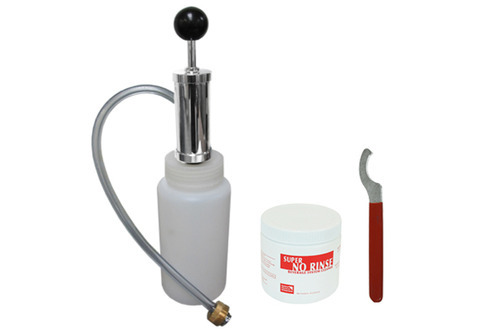
Use compatible beer line cleaning equipment and solutions, and clean faucets and couplers as instructed. Keep the condenser free of dust and maintain it according to the refrigerator manual. For pouring problems, our foamy beer guide explains the temperature, pressure and line checks.
Frequently Asked Questions
What is the best commercial kegerator?
Can I use a commercial kegerator at home?
Do I need an outdoor-rated kegerator on a covered patio?
Does each faucet need a separate keg?
What temperature should a kegerator be set to?
Is a kegerator worth it for a small bar?
What affects the cost of a commercial beer tap system?
Still Not Sure Which Kegerator You Need?
Send us how many beers you want to pour, the keg sizes your distributor delivers and the space you have. We will suggest a setup that fits. Email sales@beveragecraft.com or browse the range below.