
All You Need to Know About CO2 Tanks for Beer Carbonation
Posted by Ron on 6th Apr 2021
Carbonation is fairly simple. Some say that all you have to do is take a CO2 tank for a keg, connect it, and that’s it! Well, not exactly. When it comes to using a CO2 tank for beer carbonation and homebrewing, there are quite a few nuances you should be aware of, from choosing the right size to making the proper connections.
That’s why you’ve got Beverage Craft specialists to let you in on all of these nuances. Let’s take a look!
What Sizes Do CO2 Tanks Come In?
When choosing for a CO2 tank, one of the first things you have to decide is what size you need. For our, homebrewers’ convenience, there is a wide variety of CO2 tank sizes - from really small, compact ones to really big, almost-impossible-to-lift ones.
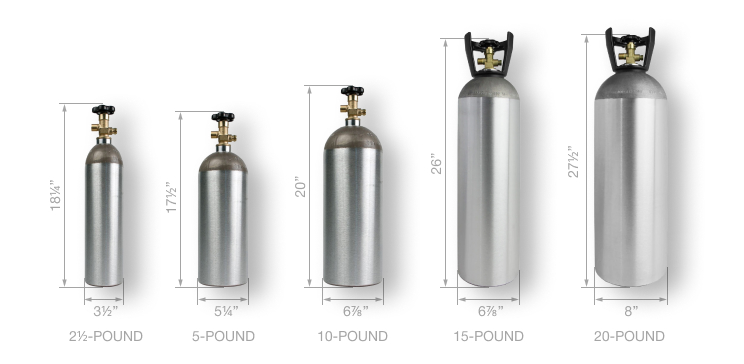
Here are some of the most common CO2 tank and CO2 bottle sizes found on the homebrewing market. You'll see the width and height in the brackets to give you an idea of the CO2 cylinder size and whether you can fit it where you want it to be:
- 2½-pound cylinder (3½’’W x 18¼’’H)
- 5-pound cylinder (5¼’’W x 17½’’H)
- 10-pound cylinder (6⅞’’W x 20’’H)
- 15-pound cylinder (6⅞’’W x 26’’H)
- 20-pound cylinder (8’’W x 27½’’H)
Naturally, you don’t need to buy a new CO2 tank every time your old one runs out of gas. Most homebrewers refill their tanks - this can be done at a draught beer store, welding supply store, fire extinguisher store, or any other place in your area that sells CO2 equipment.
What Size CO2 Tank for Homebrew
If you’re still asking yourself “what size CO2 tank should I get?” we can help you out with a few common tips. The basic idea is this: what size CO2 tank for keg you should get for your brewing equipment depends mainly on three things:
- the type of kegs and beer (and therefore, pressure) you are using
- how often you would like to refill your CO2 tank
- how comfortable you are with a particular keg size and weight
Plus, there’s the price factor as well - obviously, bigger tanks will cost you more. For example, if your homebrewing equipment features corny kegs (5-gallon capacity), a small 2½-pound CO2 tank will dispense for about 7 to 11 kegs while a 10-pound CO2 tank can last up to 44 kegs.
How to Use a CO2 Tank: Tips and Warnings
Learning how to use a CO2 tank is not really difficult. The two most common problems you might run into are connecting the tank properly and setting the right pressure. Let’s see how it’s done.
To connect your CO2 tank for beer, you need to do the following:
- connect the CO2 regulator to the CO2 cylinder and securely tighten the tank nut to prevent gas leaks
- attach the CO2 gas tubing (aka “the air line”, usually red) to the CO2 regulator outlet nipple and secure it with a clamp
- connect the other end of the gas tubing to the CO2 pressure inlet nipple on the keg coupler and secure it with a clamp as well
Follow the cylinder and regulator manufacturer’s instructions when opening the CO2 valve, and check the connections for leaks using an approved leak-detection solution. Set the outlet pressure according to the beer temperature, carbonation level and draft system requirements. Follow the brewery’s recommended dispensing pressure where available; 12 PSI is not a universal setting for every beer or system.
Setting the right pressure for CO2 tanks for kegerators is important because it prevents over- or under-carbonation and generally ensure the keg remains perfectly balanced throughout its service life.
What Is the Pressure in a CO2 Cartridge?
CO2 cartridges are tiny little containers made of steel, filled with 100% pure CO2. How much pressure does a CO2 cartridge hold? Typically, it’s around 900 psi at room temperature however, it may decrease when the ambient temperature is low and increase when it’s hot.
A dual-gauge primary CO2 regulator has a high-pressure gauge that shows cylinder pressure and a low-pressure gauge that shows outlet pressure. A secondary regulator controls the pressure supplied to individual kegs; it does not measure the amount of CO2 remaining in the tank.
For a better pour, you can use the flow control faucet to reduce foam and the pressure reducer to accommodate various styles of beer.
How Many Kegs You Get Out of a CO2 Tank
The table below shows approximately how many kegs different CO2 tank sizes can dispense. These estimates apply to serving already-carbonated beer and should be used as a planning guide, not a guaranteed tank yield.
| 2½ Pound Cylinder | 5 Pound Cylinder | 10 Pound Cylinder | 15 Pound Cylinder | 20 Pound Cylinder | |
| Homebrew
(5 gallons) |
7-11 | 15-22 | 31-44 | 46-66 | 62-87 |
| Corny keg
(5 gallons) |
7-11 | 15-22 | 31-44 | 46-66 | 62-87 |
| Sixth barrel
(5.23 gallons) |
7-11 | 14-21 | 29-42 | 44-63 | 59-83 |
| Quarter barrel
(7.75 gallons) |
5-7 | 10-14 | 20-28 | 30-42 | 40-56 |
| Half barrel
(15.50 gallons) |
2-4 | 5-7 | 10-14 | 15-21 | 20-28 |
Actual CO2 consumption depends on dispensing pressure, system setup and gas losses. Force carbonation, keg purging and repeated venting use additional CO2 and reduce the number of kegs a tank can serve. All keg volumes shown are in US gallons.
How Long Does a CO2 Cartridge Last for Serving a Keg?
A CO2 cartridge’s dispensing capacity depends on its gas weight, keg volume and serving pressure. Check the cartridge and dispensing equipment specifications to confirm compatibility and expected capacity. Using a cartridge for carbonation as well as dispensing will consume additional CO2.
For larger refillable tanks, estimated dispensing capacity is approximately 15–22 five-gallon Corny kegs from a 5-pound CO2 tank or 31–44 from a 10-pound tank. These estimates apply to dispensing already-carbonated beer. Force carbonation, keg purging and gas losses will reduce the number of kegs a tank can serve.
When dispensing a North American lager such as Budweiser, Miller or Coors, follow the brewery’s recommended pressure and temperature settings. CO2 cylinders may be installed inside or outside the kegerator where permitted by the equipment manufacturer. Keep the cylinder upright and secured. Cooling the cylinder lowers its pressure gauge reading, but does not mean that CO2 has been lost.